Day 21 - Thursday, April 25 - Egypt Mount Sinai and Suez
Today we left Nuweiba for what is called the traditional Mount Sinai. Of this, Queen Helena, the fourth-century A.D. mother of Constantine the Great, was told (apparently -also- in one of her dreams) that Moses received the Ten Commandments. Before the Israeli authorities returned the Sinai desert to Egypt several decades ago, archaeologists and scientists thoroughly searched the entire desert and were unable to find any evidence of the Exodus. This is a major reason that many no longer believe that this Exodus ever took place. Have they perhaps been looking in the wrong place? The apostle Paul writes about "Sinai, a mountain in Arabia" in Galatians 4:25, and he himself went to Arabia for a period of less than three years, according to Galatians 1:17, 18.
Like the mountain in Saudi Arabia, this mountain appears to have only one peak at the front, but there are actually more, so again it is a 'mountain range'. Climbing is done all the way at the back, with 1,200 steps that take about 2.5 to 3 hours.
And now that we have seen this mountain with our own eyes, there are quite a few things missing that would be necessary to make this mountain plausible. Such as:
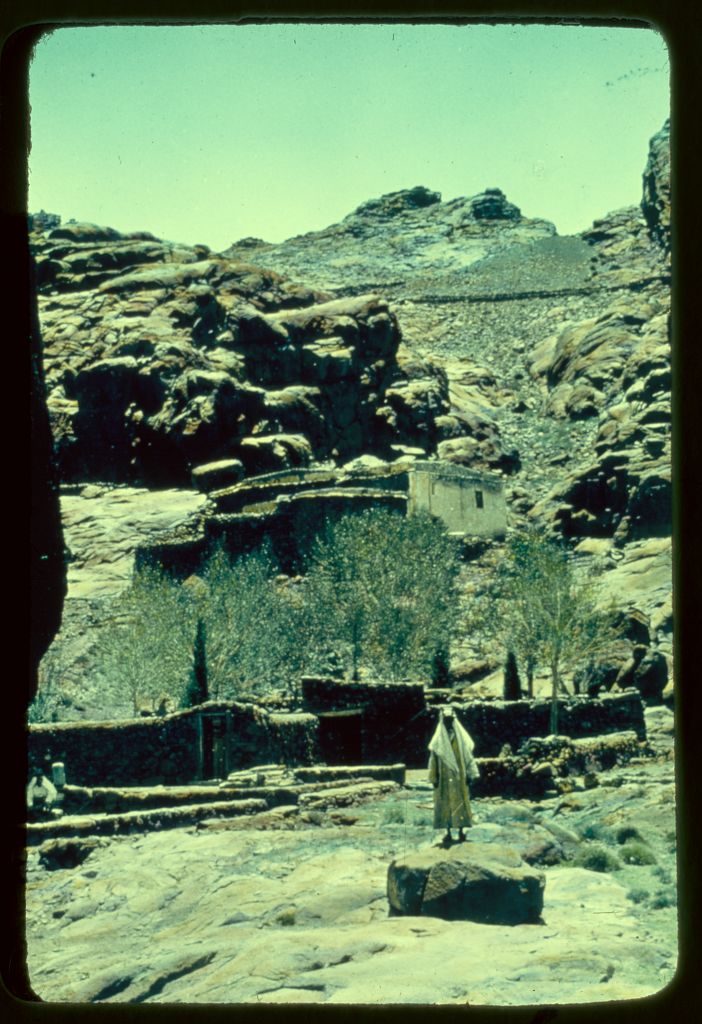
(1) We were unable to discover a cave of Elijah. There is a chapel in honor of Elijah that is very aptly called "the cave of Elijah," only unfortunately without a cave (www.loc.gov/item/2019705685).
(2) The clearing before the mountain (though now partially cultivated), is not large enough to give such a large group of people room to live in tents.
(3) There is so little vegetation that this would not have been a reason for Moses to go here with the sheep. Then it would be much better to stay in Midian, not to mention other practical objections. Yet Josephus wrote: "the mountain called Sinai [was] the highest of all the mountains thereabout, and the best for pasturage, the herbage being good there." It does seem more logical that Moses was still in Midian when he saw the burning thornbush close to the 'Mountain of God'.
(4) If you are at the summit, and you can do this even with Google Earth, you will find that there are at least three peaks in the vicinity that are higher. While both Josephus Flavius as well as Philo have written that the mountain of the True God would be the highest in the wider area "the loftiest and most sacred mountain in that district.... a mountain which was very difficult of access and very hard to ascend" (Philo, c. 20 B.C.- 40 G.T.).
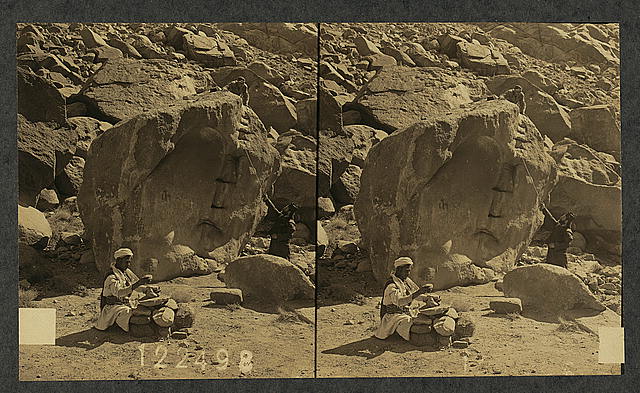
(5) We were unable to find any split rock, and what I understand is that there is one designated somewhere (www.loc.gov/pictures/item/2004672853), but it is neither split nor particularly impressive, especially compared to the one on Day 16 on April 20.
(6) But one of the main objections is that just as today the entire Sinai desert is part of Egypt, so it was at the time of Moses and the Exodus. Whereas it is clear that they had fled from Egypt with the Exodus, so then the "mountain of God" cannot be in Egyptian territory.
I had hoped that there would be books for sale there that would try to "defend" this place as the real Mount of Moses but I could not find those either, only some about the monastery and nature.
After this visit to the mountain in Sinai we went with a car towards Cairo and past the place where, according to tradition, the Israelites would have landed again after crossing the Red Sea. Unfortunately it was particularly hazy so the other side could hardly be seen and even less on the photo. But from the looks of it no mountains on that side where they would have entered the water, nor does it seem possible that they would have been "trapped" there by the wilderness, they could have continued their journey further south if they had needed to, instead of being "trapped" between the Egyptians and the sea. But to establish this with more certainty we now have "our correspondent in Cairo," and he has since taken photos and videos on a clear day.
To make a proper assessment, the main question is whether at Suez, coming from the north, they would have been "closed in" by the mountains or whether there would be open space to the south that would have allowed them to easily escape or at least flee further in case the mountains or hills do not run right up to the sea. The answer we received was "yes, it's open from two sides," and "there is a space between mountains and hills and the sea shore about 2-3 kilometers", and that is clear to see on the videos and pictures.
After an interesting trip in the evening through 'horn-rich Cairo' we arrived at the hotel.
Videos:
(1) On the way through the Sinai desert. (2) The traditional mountain. (3) The mountain range with its various peaks. (4) The plain before the traditional mountain. (5) Taken from the possible approximately crossing spot and from north-west to south-west [see photo 7, the brown part of the circle] via the east, thus overlooking the Red Sea. (6) Taken from the possible approximately crossing spot and from north-west to south-west [see photo 7, the green part of the circle] but now via the west, thus overlooking the low mountains in the background at quite a distance from the Red Sea.
Photos:
(1) Part of the courtyard of our hotel in Nuweiba. (2-3) The familiar front view of the traditional Mount Sinai. (4) From an ancient archive, the cave of Elijah that is not there, only a little church by that name. (5) Also from an ancient archive, the split rock that is not split. (6) Starting on the opposite side, the traditional spot where the Israelites crossed the Red Sea with the Exodus. You can very vaguely see the boats sailing toward the Suez Canal, and behind them you can see no vague outline of mountains or hills. (7) Map showing the blue circle from where the videos and photos were taken, at the spot of the traditional crossing of the Red Sea, with in light brown the view that you see in video 5 and in green what you see in video 6. (8) Ships waiting for their turn to enter the Suez Canal. (9) View of the large open space between the hills and the Red Sea toward the south-west.